| China University of Petroleum | |||
| Chinese | |||
|
|
||||||
More than 94% of Brazil's oil and 84% of its natural gas reserves are located in offshore deep-water sub-salt oil and gas fields, which have great exploration and development potential. The country is rich in oil and gas resources and is expected to become the world's largest oil producer outside the Organization of Petroleum Exporting Countries. It is of great significance for China to diversify its crude oil import sources and ensure energy security. Recently, Professor Yao Jun of the Institute of Petroleum Engineering introduced thelatest research results of carbonate reservoir numerical simulation and cooperation with Brazilian universities at the China-Brazil Marine Science and Technology Innovation Forum sponsored by CNOOC.
This year coincides with the 50th anniversary of the establishment of diplomatic relations between China and Brazil. The cooperation between China and Brazil in the field of petroleum energy is highly strategic and complementary, with great development potential. In recent years, the School of Petroleum Engineering of our school has continuously deepened cooperation with Brazilian Federal University of Rio de Janeiro and other universities in scientific research and talent training, and continuously promoted the scientific and educational cooperation between Chinese and Brazilian universities. The G20 Summit will be held in Rio de Janeiro, Brazil from November 18 to 19, providing new opportunities for further deepening cooperation between universities of the two countries.
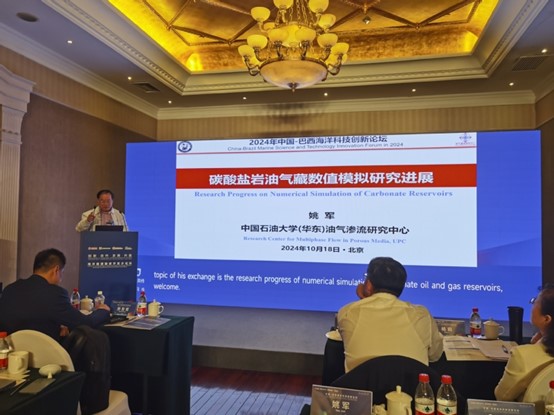
Professor Yao Jun delivered a presentation at the 'China-Brazil Forum on Marine Science and Technology Innovation'
Santos Basin in the southeastern waters of Brazil is currently the richest area ofsubsalt oil and gasin the world, with a cumulative proven oil reserves of 4.81 billion tons and more than 2 trillion cubic meters of natural gas. Clarifying the distribution law of oil and gas reservoirs in this area is helpful to improve the efficiency of oil and gas development in Brazil. However, the carbonate reservoir rich in oil and gasis covered with seawater of depth 2000 meters, salt formation of 1000 meters and salt formation of 2000 meters. It is not easy to uncover the veil of ultra-deep oil and gas reservoir under salt.
In recent years, Professor Yao Jun's team has focused on the coupling of seepage and free flow in the exploitation of fractured and vuggy carbonate reservoirs, proposed discrete fracture and vuggy network model, and developed numerical simulation methods and software for fractured and vuggy carbonate reservoirs considering multiphase and multicomponent,fluid-solid couplingandacid-rockreaction flow. Starting from the microscopic N-S equations of oil-water two-phase flow, the team established the macroscopic two-phase percolation-free flow coupling interface conditions for the first time by using the volume averaging method, and designed and measured the velocity profile distribution of percolation-free flow based on laser Doppler velocimetry (LDA) for the first time.
Professor M.Carvalho, winner of the Outstanding Contribution Award of the International Association of Surface Coating Science and Technology and the Catholic University of Rio de Janeiro, Brazil, verified the correctness of the numerical simulation of percolation and free flow proposed by Professor Yao Jun's team. Cristian Mejia et al. of Catholic University of Rio de Janeiro said in the article published inJournal of Natural Gas Science and Engineeringthat the discrete fracture and cavity network model and relatedfluid-solid couplingnumerical simulation research method and technology proposed by Professor Yao Jun team are being applied in Lula and Tupi oilfield blocks of Santos Basin in Brazil, which is helpful for the research on seepage theory and technical policy for efficient development of Brazilian offshore carbonate oil and gas reservoirs, and provides theoretical support for efficient development, increased reserves and increased production of ultra-deep water oil fields under salt in Brazil.
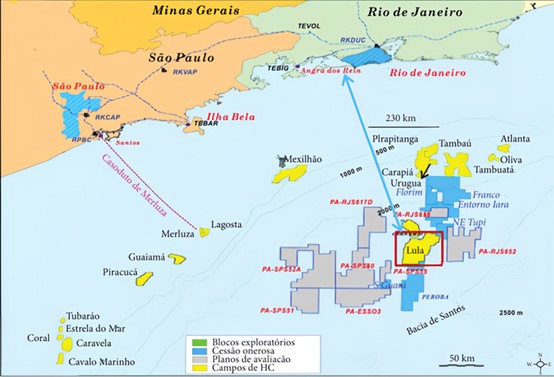
Schematic diagram of the Lula and Tupi oil field blocks in Brazil's Santos Basin
Professor Sun Baojiang, as the head of Innovation and Intelligence Base for Offshore Oil and Gas Engineering, has carried out long-term scientific and technological cooperation with Professor Renato Cotta, academician of Brazilian Academy of Sciences, Academy of Engineering and World Academy of Sciences, and Professor Segen Estefen, academician of Brazilian Academy of Sciences and Academy of Engineering, in the fields of deepwater offshore oil and gas engineering equipment, multiphase flow and safety control of deepwater oil and gas wellbore. Academician SeigenEstefensaid,Petrobras and China Energy Corporation in Brazil represented by CNOOC Brazil are vigorously promoting the development of Brazil's deepwater sub-salt oil and gas fields, but they face huge technical challenges in the process. It is urgent for both sides to achieve breakthroughs in ultra-deepwater technology through strengthening scientific and technological exchanges and cooperation.
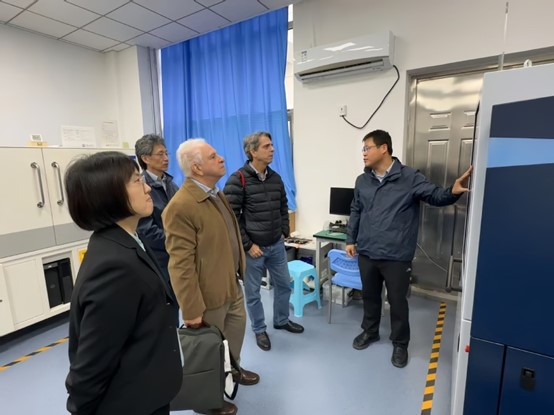
Academician Segen Estefen's team visited the university laboratory
In recent years, Professor Sun Baojiang's team cooperated with CNOOC International Energy Company to solve the problems such as easy creep of salt layer and narrow safety density window faced by drilling in Brazil's extremely thick salt layer. Considering the wellbore-formation coupling mechanism of drilling in deep water extremely thick salt layer, Professor Sun Baojiang established the early warning technology of drilling sticking risk in extremely thick salt layer, and formed thefine control technology of wellbore pressure applicable to extremely thick salt layer. The achievements have been applied in several deepwater blocks in Brazil, effectively avoiding the occurrence of sticking, well kick and lost circulation, reducing the non-production operation time of drilling, and providing technical support for safe and efficient drilling in deep water and extremely thick salt layers in Brazil.
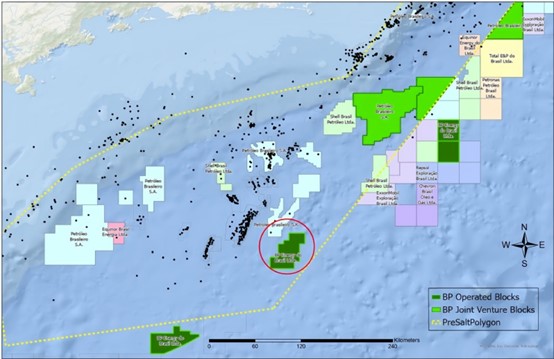
Schematic diagram of a certain salt layer block in Brazil's Santos Basin
Associate Professor Fu Guangming cooperated with AcademicianSegenEstefenteam focusing on the difficult problem of safe oil and gas transportation under deep water low temperature and high pressure environment, carried out a large number of basic theoretical research and forward-looking technology exploration around the safety design of deep water sandwich composite pipeline, jointly undertook 2 projects of Safety Evaluation of Deep Water Sandwich Composite Pipeline National Natural Science Foundation, 1 project of Natural Science Foundation of Shandong Province, and 1 project of forward-looking project Structural Integrity Evaluation of Sandwich Pipeline of Sinochem Brazil Company.
Deepwater sandwich composite pipeline technology has significant advantages in Brazil's deep-sea oil and gas development and transportation. However, the deep-sea high-pressure environment makes the pipeline bear huge external hydrostatic pressure, which may lead to instability failure of the whole pipeline, resulting in significant economic losses and ecological impacts. Therefore, it is of great engineering significance to carry out pipeline safety research for Brazil's deep-water oil fields. Fu Guangming said. Through joint research, the teams of both parties have made remarkable progress in safety evaluation and structural design of deep-water sandwich composite pipeline, dynamic response of deep-water composite pipeline, etc., revealed the dynamic collapse propagation mechanism of deep-water sandwich insulation pipeline, established the engineering design formula of sandwich composite pipelinecollapse and collapse propagation, obtained 1 computer software copyright, and selected 2 ESI highly cited papers as core research papers. Relevant achievements are directly adopted by China Engineering Construction Standardization Association standards.
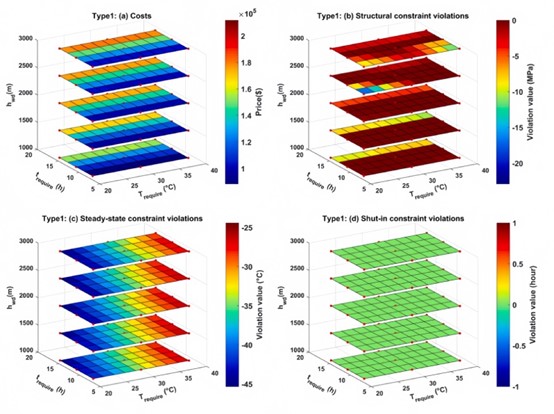
Partial optimization calculation results of deepwater composite pipelines
The Institute of Petroleum Engineering has a long history of scientific and educational cooperation with universities such as the Federal University of Rio de Janeiro in Brazil. Since 2012, the two sides have held more than 10 multi-level negotiations on technical cooperation in offshore oil and gas development and joint training of high-level talents, signed MOU cooperation memoranda twice, invited Brazilian experts and scholars in the field of energy to the university and online exchanges for more than 30 times relying on the platform of Innovation and Intelligence Base for Offshore Oil and Gas Engineering, led delegations to visit Brazilian Federal University of Rio de Janeiro, University of Sao Paulo, CNOOC Brazil Company, Sinopec Brazil Company and otheruniversities and Chinese-funded energy enterprises for three times, and continuously promoted international project cooperation, joint training of masters and doctors, and exchange visits of high-end experts.
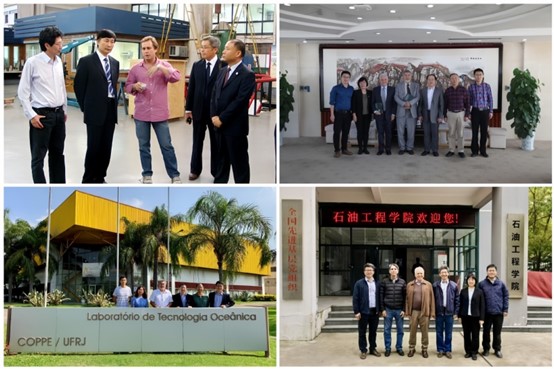
The academy has had multiple exchanges and visits with the Federal University of Rio de Janeiro
Recently, Professor Jean-David, Vice President of the Institute of Engineering Technology of the Federal University of Rio de Janeiro, Professor Su Jian, Director of the Department of Nuclear Engineering , and Professor Marcelo Igor, Director of the Department of Marine Engineering, came to the Institute to discuss matters such as joint training of graduate students. It is planned to carry outexchange visits for master and doctoral students in 2025,and strive to achieve breakthroughs in the double doctoral degreeproject. From a strategic perspective, China-Brazil energy technology cooperation helps to achieve complementary advantages and mutual benefit; from the institutional level, the Federal University of Rio de Janeiro, as Brazil's largest federal university, has a century-old history and international reputation, and the Petroleum Engineering Institute, as a 'double-first-class' construction institute, promotes the sharing of high-quality education and scientific research resources, which is conducive to the common development of both sides. Professor Jean-David is confident in the cooperation between the two sides. “
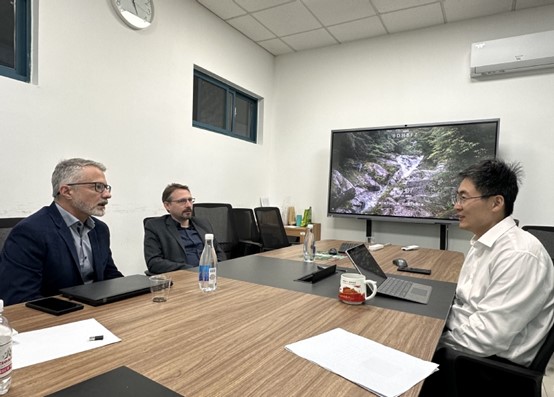
The academy is discussing joint graduate training programs with the Federal University of Rio de Janeiro
In recent years, the cooperation between the college and Brazilian universities in personnel training has achieved many results. Jointly applied for 2 national high-level talent projects with the Federal University of Rio de Janeiro, Brazil, participated in the co-construction of Innovation and Intelligence Base for Marine Oil and Gas Engineering and obtained continuous funding, jointly undertook 1 international cooperation training project of unconventional oil and gas and green energy development; implemented the joint training plan of double tutors for graduate students, jointly trained 7 master and doctoral students with the University of Rio de Janeiro, and jointly published 19 academic papers, including 2 ESI highlycited papers, 12 SCI Zone I papers and 2 SCI Zone II papers in marine field.
Recently, President Xi Jinping mentioned in his reply to Brazilian friends that he hoped people from all walks of life in the two countries would play an active role in promoting the continuous development of China-Brazil relations. In the next step, the Institute of Petroleum Engineeringwill seizethe new opportunities for cooperation with Brazilian universities, steadily expand new fields and new spaces for cooperation, promote the two-way flow of talents, integrate scientific and technological innovation resources, promotecultural inter-embedding and integration, inject vitality into further deepening scientific and educational cooperation between the two sides, and contribute to enhancing the international influence of the school.
|
PROGRAMS Undergraduates Master Doctoral Postdocs |
RESEARCH Drilling Production Reservoir Oilfield Chemistry Offshore O&G Ocean Engineering |
INTERNATIONAL International students Study abroad International Joint Lab International Visits |
CONTACTS US
|