| China University of Petroleum | |||
| Chinese | |||
|
|
||||||
On May9, the Exploration and Development Research Institute of Shengli Oilfield Branch and the School of PetroleumEngineering held the 2026Annual Science and Technology Exchange Conference, namely the high-water cut old oilfield and unconventional oil and gas development technology exchange meetingHeld at our school. Han Zhenlong, Party Secretary of the Exploration and Development Research Institute of Shengli Oilfield Branch, Cao Xiaopeng, President; Dai Caili, Vice President of China University of Petroleum (East China); Zhang Kai, President of Qingdao University of Technology; Hou Jian, Dean of the School of Petroleum Engineering; Wang Zhiyuan, Party Secretary; Yang Yongfei, Executive Deputy Director of the Belt and Road National Laboratory; as well as researchers and teachers from both sides attended the meeting.
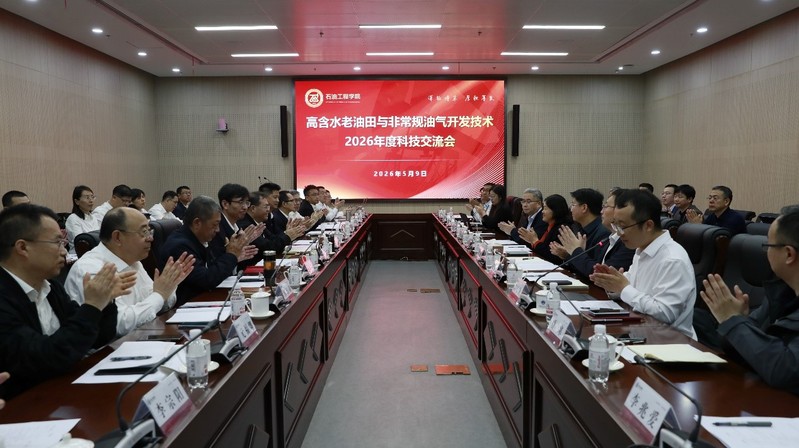
Dai Caili delivered a welcome speech, warmly welcoming the delegation from the Exploration and Development Research Institute of Shengli Oilfield Branch. She pointed out that since2010, Over the years, the exchange mechanism between the two institutes has been long-term and stable, with both sides maintaining close communication and cooperation. Coinciding with the first year of the 15th Five-Year Plan, both the university and Shengli Oilfield are conducting macro-level planning and scientific planning. Currently, whether it is improving recovery rates in old oilfields, developing unconventional oil and gas, or deepening oil and gas extraction, they all face new challenges. They look forward to leveraging the university's scientific research capabilities and relying on Shengli's rich experimental fields to deeply integrate technological innovation with enterprise innovation, improve theoretical and technical research capabilities in oil and gas development, accelerate the transformation and implementation of results, and jointly contribute to improving national energy security. We look forward to both sides jointly building organized scientific research to help the 15th Five-Year Plan start more steadily and move from victory to victory.
Han Zhenlong stated that the institute has maintained a good cooperative relationship with the university and the college for a long time, and he thanked the university and college for supplying a large number of highly qualified talents to the institute. He reviewed General Secretary Xi Jinping's inspection of the Exploration and Development Research Institute, where he gave the institute a high-level position and earnest entrustment as a flag pillar, and introduced the institute's remarkable scientific and technological achievements in recent years in the field of oil and gas exploration and development. He pointed out that integrated construction of petroleum exploration and development and geological engineering is the only way forward. He looks forward to leveraging the university's strong research capabilities and the institute's rich practice of science-industry-innovation innovation, further expanding cooperation in jointly building innovation consortia, jointly promoting key technology breakthroughs, and cultivating high-quality scientific research talents, advancing hand in hand, and making new and greater contributions to securing the energy supply and ensuring national energy security.
Guo Tiankui, Vice Dean of the College, and Lü Qi, Vice President of the Institute of Exploration and Development, respectively presided over the exchange meeting. The conference focused on 16 special presentations focusing on areas such as water flooding to improve recovery in medium- and high-permeability reservoirs, artificial intelligence applications, low-permeability reservoir pressure flooding technology, efficient three-dimensional shale oil development technology, carbon shale flooding and storage technology, heavy oil reservoir recovery enhancement technology, and chemical flooding enhancement technology. Both sides summarized research progress since the 14th Five-Year Plan, analyzed the main existing issues, and laid out the research directions for the 15th Five-Year Plan. A detailed discussion was held on the technical challenges bottlenecks in production and the key entry points for tackling key core technologies.
In his summary, Cao Xiaopeng pointed out that this exchange conference featured16academic presentations, focusing on cutting-edge technologies in oil and gas development and practical challenges urgently needed to be solved on site. The content was substantial, the discussions in-depth, and the gains were substantial, effectively building a platform for collaborative innovation and innovation between both sides. He firmly believes that the cooperation between the two sides during the 15th Five-Year Plan is timely and full of potential in scientific research and talent sharing. At the same time, he put forward three cooperation expectations: First, further breakthroughs in scientific research and innovation, relying on the foundation of cooperation between both sides, jointly tackling key core technologies in the oil and gas field; Second, talent co-cultivation further improves quality, leveraging the college's talent cultivation advantages and oilfield practical strengths to support talent cultivation and growth in both directions; Third, deepen exchanges and exchanges, regularly carry out academic exchanges and project visits, continuously broaden cooperation areas, and create good development opportunities together.
Hou Jian stated that regular academic exchanges at the institute are a fine tradition passed down over many years. The institute's research achievements closely align with actual on-site production, the research system is complete and highly practical, and the technology is implemented. Through this exchange, both parties further exchanged information, clarified industry development hotspots, and practical on-site needs, laying a solid foundation for precise alignment and deepening cooperation in the next steps. He proposed three directions for cooperation: First, focus on organized scientific research, with both sides jointly applying for major research projects; Second, deepen joint talent cultivation, strengthen joint training for engineering master's and research doctoral programs, and enhance the application process for national-level talent recruitment through university-enterprise joint appointments; Third, promote platform resource sharing, open up high-end laboratory testing platforms between schools and enterprises, integrate advantageous resources to empower high-quality development, and promote long-term, stable, deep, and lasting cooperation between institutes and institutes.
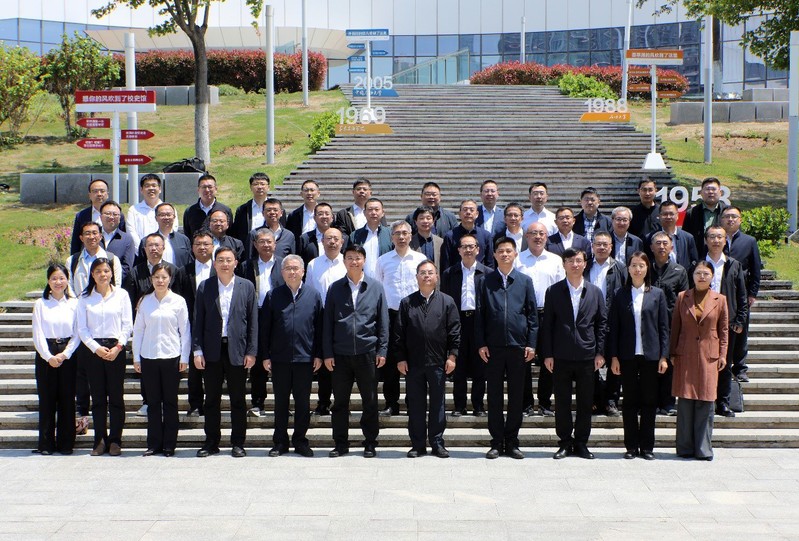
Our institute has maintained a long-term friendly cooperative relationship with the Exploration and Development Research Institute of Shengli Oilfield Branch. Since signing the comprehensive cooperation agreement in 2010, both parties have carried out strong cooperation in talent cultivation, scientific research, and social services, achieving fruitful results. The technical exchange meetings held every two years provide a strong platform for targeted cooperation.
|
PROGRAMS Undergraduates Master Doctoral Postdocs |
RESEARCH Drilling Production Reservoir Oilfield Chemistry Offshore O&G Ocean Engineering |
INTERNATIONAL International students Study abroad International Joint Lab International Visits |
CONTACTS US
|