| China University of Petroleum | |||
| Chinese | |||
|
|
||||||
Recently, multiple media outlets including China Industry News Network and Shandong Education Dailyreported onthe project Key Technologies and Applications of Water Control and Oil Enhancement in Temperature-Resistant and Salt-Resistant Gel Dispersion Systems for Temperature-Resistant and Salt-Resistant Gel Dispersion Systems, led by Professor Dai Caili's team.
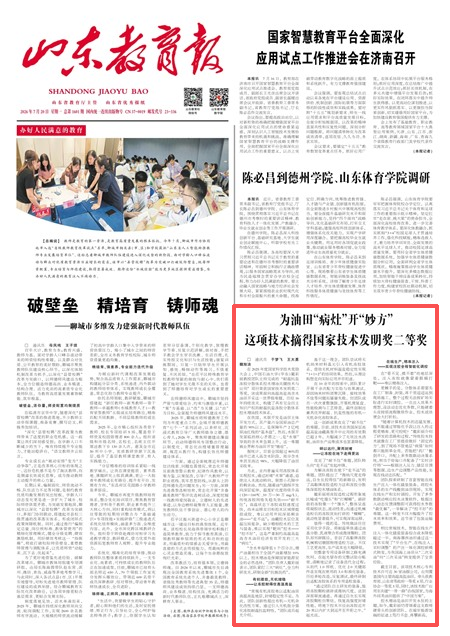
Screenshot of the report
The core technology of high-temperature and high-salinity oilfield water control and oil enhancement won the second prize of the National Technological Invention Award
China University of Petroleum (East China) has built a fully independent technology system to provide solid technological support for stable crude oil production and supply
At the recently held 2025 National Science and Technology Awards Conference, the project Key Technologies and Applications for Water Control and Oil Enhancement in Temperature-Resistant and Anti-Salt Gel Dispersion System, led by Professor Dai Caili's team from China University of Petroleum (East China), officially won the National Technology Invention Second Prize. This original achievement, which directly addresses the pain points of high-temperature, high-salinity, high-water oilfield extraction, has been continuously tackling three core technical bottlenecks over 16 years, establishing a water control and oil enhancement technology system with fully independent intellectual property rights, breaking down technical barriers in deep, extreme reservoir development, and providing key industrial technical support to ensure national energy supply security.

As the main development model of China's oilfields, hydro-driven development contributes over 90% of the country's crude oil production and serves as the ballast stone for maintaining the annual 200 million ton crude oil production line and strengthening the energy security defense line. However, as development years increase, the injected water easily forms ineffective circulation along formation fractures, large channels, and other high-permeability channels, causing the water cut of the oil well to rise sharply, while the remaining oil in small pores becomes difficult to effectively utilize. This contradiction, known in the industry as a chronic problem in oilfield development, is becoming increasingly prominent as the development of old oilfields deepens: data shows that over 80% of oil wells nationwide have entered the high-water cut development stage, with some old oilfields having water content exceeding 98%, directly lowering oil recovery and production efficiency, becoming the core bottleneck restricting stable crude oil production.

To address this common industry challenge, the traditional solution is to use polymers and crosslinkers to form a gel system to block high-permeability channels, forcing the injected water to divert and displace the remaining oil. However, as oil and gas exploration continues to extend deeper, reservoir temperatures and mineralization continue to rise (120-160°C, 100,000-300,000 mg/L), exposing the shortcomings of traditional gel freezing technology, forming three major insurmountable industrial bottlenecks: First, polymer molecular chains easily break under high temperature and high salt conditions, instability and failure of the gel freezing network structure, short sealing cycles, and unable tolerate extreme deep conditions; Second, gel formation happens too quickly in high-temperature environments, with frozen gel forming prematurely before moving to the target area, only covering the near-well area and unable to reach the remaining deep oil between wells, limiting development effectiveness; Third, reservoir stratification and temperature-pressure field conditions are complex, lacking refined control processes and equipment, making targeted sealing difficult, and poor control affecting water control accuracy. The combination of these three major pain points has become the core technical barrier for the economical and efficient development of high-temperature, high-salinity, high-water oilfields.
For every 1 percentage point reduction in water content, the increase in oil production is equivalent to a more than 10% increase in national oil production. Water control and oil increase are the eternal themes of oilfield development and an inevitable choice to ensure national energy security. Dai Caili stated that the team is precisely targeting these three major industry pain points, tackling challenges with sixteen years of determination, creating a domestically developed effective water control and oil enhancement formula suited to deep reservoirs.
Organic-inorganic collaborative modification solves the problem of unable to endure high temperature and high salt.
Conventional organic gel systems are difficult to adapt to deep, high-temperature, high-salinity strata, and insufficient sealing stability has been a common problem in the industry for many years. The team broke away from traditional organic material R&D approaches and innovatively proposed an organic-inorganic hybrid modification technology route—introducing inorganic nanomaterial primitives into the organic freezer system, leveraging the excellent temperature and salt stability of inorganic materials to achieve synergistic synergy of organic and inorganic components in 1+1>2, thereby fundamentally improving the temperature and salt resistance of the gel.
The road from theoretical conception to project implementation is full of obstacles. Over more than ten years of R&D, the team conducted over a thousand formulation experiments and performance tests, encountering multiple bottlenecks such as nanomaterial agglomeration and settling, poor grafting modification effects, and substandard temperature and salt resistance indicators, with multiple experiments ending in failure. The research team did not stop there; instead, they successively reviewed mechanisms, tested performance, and conducted process investigations, tackling technical challenges one by one, ultimately succeeding in creating an organic-inorganic hybrid gel system with excellent temperature resistance and salt resistance, thoroughly overcoming the industry's pain points that traditional cryoplastics could not withstand from the material side.
On-site application data confirmed the technical solidity: this hybrid gel gel technology has been effective for over two years in typical wells in China's deep high-temperature, high-salinity reservoirs, with outstanding long-term water control and oil stabilization effects. Technical experts from Northwest Oilfield have evaluated that this independently developed technology effectively blocks reservoir water runways, significantly reduces ineffective water injection consumption, lowers oilfield production and operation costs, and provides a reliable domestic technology path for efficient and stable production in similar high-temperature, high-salinity water-flooded oilfields.
Physical pelletizing and deep transport break through the bottleneck where frozen glue can't go far.
Having solved the fundamental problem of material performance, the team immediately launched a breakthrough into the industry's bottleneck of deep frozen rubber transport. To address the problem of traditional frozen gum forming quickly and difficult to penetrate deep into the reservoir, the team proposed a new technical approach: Traveling far at micro-nano scale, controlling self-growth, and invented a high-viscosity elastic gel granulation method and a deep water control and oil enhancement system for frozen gel dispersions.
Dai Caili vividly likens this principle to battering: a complete gel is like a whole steamed bun, in a continuous gel state, with poor fluidity and only functioning near the well; The gel formed by mechanical granulation and crushing resembles a fine paste, greatly improving fluidity. It can be transported deep into the reservoir with injected water, reach the target runoff channel, and then self-grow to achieve cohesion and re-coagulation, restoring high-strength sealing performance.
Unlike traditional chemical synthetic granulation processes in the industry, the team pioneered a high-viscosity elastic gel mechanical shearing, rounding, and physical pelletizing method, which not only significantly improved production efficiency but also significantly reduced manufacturing costs. To adapt to this new process, the team simultaneously launched dedicated equipment development. From the initial 1.0 prototype, optimized key 2.0 components, to the final 3.0 standardized equipment, they underwent multiple rounds of iterative modifications, solving engineering issues such as uneven shearing, uncontrolled particle size, and equipment wear, ultimately developing specialized granulation equipment suitable for this freeze adhesive system.
This technological breakthrough directly expands the reservoir's water control boundary: the underground water control radius has increased from within 20 meters of the traditional frozen rubber near the well to a distant well and even half the well distance, truly achieving effective regulation of deep high-permeability channels and efficiently utilizing remaining deep oil.
Intelligent online precise regulation solves the problem of targeted water control being hard to control.
The deep reservoirs are invisible and intangible, and traditional water control technologies generally rely on a factory prefabrication, on-site injection model, which cannot adjust parameters based on real-time formation feedback. It is like blindfolded targeting, making precise targeted water control difficult. At the same time, packaging and long-distance transportation of prefabricated products have also driven up overall application costs.
To address this pain point, the team deeply integrated intelligent technology with oilfield development processes, proposing a revolutionary solution of online production and real-time control, directly moving the freeze glue production line to the oilfield wellhead. The team developed China's first set of intelligent online production injection integrated skid-mounted equipment, along with multi-parameter linked response water control decision software. It can adjust formulas and injection parameters in real time based on on-site dynamic data such as injection pressure and reservoir feedback—essentially equipping each well with a real-time diagnosis and treatment system that dynamically adjusts the prescription based on the formation's condition, achieving precise matching of water control processes.
This model completely breaks the application limitations of traditional prefabricated products, greatly improving water control efficiency and eliminating costs in packaging and transportation. Data shows that compared to conventional technology, the comprehensive application cost of this integrated skid-mounted equipment is reduced by more than 50%. In the application of the Weizhou Oilfield in the South China Sea, this technology successfully achieves integrated production and injection regulation with platform production, online injection, and real-time adjustment, providing a replicable practical example for China's offshore oilfields to upgrade and transform from secondary oil recovery to tertiary oil extraction.
To date, this technology system covers major domestic high-temperature and high-salinity oilfields, providing important technical support for stable domestic crude oil production of 200 million tons; At the same time, it has been promoted and applied to countries along the Belt and Road, contributing Chinese solutions to the development of similar oilfields worldwide. The project's core patents have been licensed for the transformation and implementation of nearly 30 oil service companies, winning four first prizes from provincial and ministerial governments such as the Ministry of Education and Shandong Province, and three first prizes from industry associations, cultivating a group of leading talents in the oil and gas field and forming a virtuous cycle of technological innovation and talent cultivation.
This achievement has achieved long-term management of high-temperature, high-salinity reservoirs with high water content. It is not only a core 'weapon' for deep extreme reservoir development but can also be expanded to various types of high-water oilfields such as heavy oil thermal extraction, low permeability, and offshore areas. It is of great significance for enhancing China's independent crude oil security capabilities and securing the energy supply base. Dai Caili stated. After sixteen years of relentless efforts, Dai Caili now leads her team to continue rooting in the front lines of oil and gas development research, deepening technological iteration and scenario expansion, fulfilling the mission of serving the nation through independent innovation, and continuously injecting technological momentum into ensuring national energy security.
China Industry News Network (July 15, 2026)
Authors: Yu Mengfei, Wang Dayong, Wei Xujie
[Shandong Education Daily] Prescribing a 'Brilliant Remedy' for Oilfield 'Disease Sites'—This technology won the Second Prize of the National Technological Invention Award_Shandong Education Daily Electronic Edition - Issue 20260720 - Page 1: News
|
PROGRAMS Undergraduates Master Doctoral Postdocs |
RESEARCH Drilling Production Reservoir Oilfield Chemistry Offshore O&G Ocean Engineering |
INTERNATIONAL International students Study abroad International Joint Lab International Visits |
CONTACTS US
|